Coaching & Workshops

He was excellent running a team and is drowning running four managers.

Managing managers is a different job, not a bigger one. This session covers the shift most people are never prepared for, from doing the work through a team to getting results through people who each have their own team.

Why it matters

The second promotion is harder than the first.

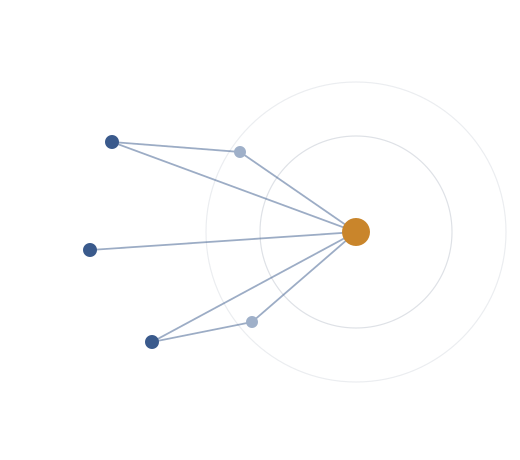
A good manager gets promoted for being close to the work and close to their people. At the next level both of those become liabilities. They keep solving problems that belong two levels down, their calendar fills with things their managers should own, and the managers themselves never quite get to lead.

The tell is a leader who knows every detail of one team and almost nothing about the other three, usually the team they came from. Everyone can see it. Nobody says it, because they are working extremely hard.

What the session covers

  • Letting go of the work. Again, and harder, because the pull is stronger at this level.
  • Managing through people. Setting direction for managers rather than tasks for doers.
  • Consistency across teams. Four managers with four standards is your problem, not theirs.
  • Developing managers. Coaching someone who is themselves a coach.

In the room

How we spend the time.

What changes at this level

A concrete sort of what they should stop doing, keep doing, and start doing, based on how they actually spent last month.

Skipping levels

When to talk directly to someone two levels down, how to do it without undermining their manager, and when not to.

Holding managers accountable

Different from holding doers accountable, and the thing most new second-level leaders find hardest.

Signs you need this

How this usually shows up.

The team they came from is usually the one they know best and manage worst, because the relationship never changed when the job did.

If two or three of these are true you are past the point where it resolves on its own. None of them are unusual, and all of them are cheaper to fix than to wait out.

Sound familiar

  • A newly promoted leader knows one team in detail and the others barely at all.
  • Their calendar is full of decisions their managers should be making.
  • The managers reporting to them have stopped bringing proposals and started bringing questions.
  • Standards differ noticeably between the teams underneath them.

Afterward

What changes.

They stop doing their managers' jobs

Which frees them for the work only they can do, and lets their managers actually manage.

Consistency across teams

Four managers running four standards becomes one standard, which is their responsibility rather than the managers'.

Their managers grow

People who were being managed as doers start being developed as leaders.

How it runs

Half a day, senior-led, no slides for the sake of slides.

Leaders newly responsible for managers rather than individual contributors, or about to be. Works well as a small peer group, since the shared experience is much of the value.

Sessions run on site or virtually, and they are built around situations attendees bring rather than case studies from a textbook. You get a fixed fee before we start, and the person who scopes it is the person who delivers it.

Practicalities

  • Half a day in most cases, longer if combined with a related session.
  • On site or virtual, whichever suits your people.
  • Built on your situations, not generic scenarios.
  • Fixed fee, agreed before anything starts.

Questions

Common questions

Who is this for?

Anyone newly responsible for managers rather than individual contributors, and anyone about to be.

Group or one-to-one?

Both work. Groups are useful because the peer conversation is often the most valuable part. One-to-one suits a single leader in a specific situation.

How is it different from the new managers workshop?

Completely. That is about leading people who do the work. This is about leading people who lead people, which is a different job with different failure modes.

How long?

A full day, or two half-days a few weeks apart so there is time to try things.

Can it be combined with coaching?

Yes, and that is the most effective format. The session sets the frame and coaching handles their specific situation.

How long does this transition normally take?

Six to twelve months to feel natural. The session accelerates it and makes the failure modes visible early, which is most of the value.

Should their own manager be involved?

A short conversation with them beforehand helps, mainly so the support afterward is consistent with what we covered.

What if they were promoted too early?

Sometimes true. We would tell you honestly what we saw, though that is a conversation with you rather than a conclusion we deliver in the room.
Related

What this pairs with.

Leadership Coaching

Ongoing one-to-one support for the transition.

Leadership Coaching →

Delegation and Letting Go

The core skill this level depends on.

Delegation and Letting Go →

Coaching Skills for Managers

Developing managers requires coaching, not instructing.

Coaching Skills for Managers →

Senior-led, delivered by the person you meet

Prepare them for the job they actually have now.

Tell us who has stepped up and we will scope a session. No obligation, and we will say if one of the others fits better.

Tell us what is going on